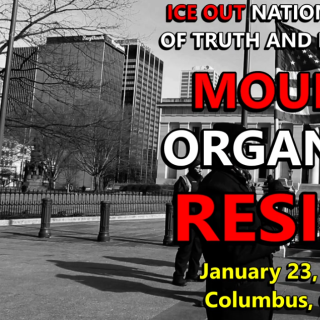
Columbus is arguing about “public safety” again — but this time, the debate isn’t happening in a City Council chamber or on the courthouse steps. It’s happening in the gap between two artifacts floating around the city like opposing flyers for the same event.
One is a statement on Fraternal Order of Police (Capital City Lodge #9) letterhead, signed by lodge president Brian Steel, insisting that while local law enforcement doesn’t have authority to enforce federal civil immigration laws, they still have an “absolute duty” to respond when federal partners ask for assistance — and that “public safety depends on cooperation.”
The other is a Facebook post from “West Columbus ICE Watch” (also calling itself Westgate ICE Watch), introducing itself as a neighborhood network formed because residents believe ICE activity is spreading, fear is rising, and people need a way to report sightings anonymously and share mutual-aid resources. The post says it plainly: they’re organizing because they don’t want “a repeat of history.”
Between those two documents sits the thing Columbus can’t stop talking about: ICE’s “Operation Buckeye,” a federal surge that ICE says is about public safety — and that city leaders say is an “unwelcome intervention.”
A surge with a name — and a fog around the factsOn paper, the storyline is simple. ICE has increased enforcement activity in Ohio under Operation Buckeye, framing it as a targeted push against people it calls “the worst of the worst.”
On the ground, the storyline is messy — because the public has been left to assemble it from social media posts, shaky photos of unmarked SUVs, and rumors moving faster than official information. Even local officials have said federal agencies aren’t communicating clearly with the city about what’s happening or where.
WOSU reported that ICE responded to questions with a statement defending enforcement actions as part of “ongoing efforts to uphold public safety and enforce federal immigration laws,” but provided limited specifics about local activity, and that much of what’s circulating online hasn’t been verified.
That lack of clarity is the gasoline. When the government’s message is “Trust us, it’s public safety,” and the public’s lived experience is “Nobody will tell us what’s happening,” the result isn’t reassurance. It’s panic — and it’s organizing.
City Hall’s message: Columbus is already safeColumbus Mayor Andrew Ginther has put his marker down: “Columbus is already safe,” and the city has not asked for federal immigration enforcement support. The mayor has also warned that this kind of operation could erode community trust in law enforcement — trust that city leaders argue has been hard-won.
That framing matters because it draws a bright line between two definitions of safety:
- Safety as enforcement: more arrests, more raids, more removals.
- Safety as trust: people calling 911 when they need help, sending kids to school without fear, and not worrying that a traffic stop becomes an immigration dragnet.
Axios reported that city officials reiterated Columbus’s long-standing position, as outlined in a 2017 executive order: City resources are not used to enforce federal immigration policy. Officials raised concerns about fear and confusion, including reports of agents being unmarked or unidentified.
The FOP: “Public safety depends on cooperation.”Now enter the FOP statement — not as a random letter, but as a piece of the city’s psychological infrastructure.
The lodge’s statement does something very specific: it concedes that local law enforcement can’t enforce federal civil immigration laws on its own, then re-centers the conversation on cooperation, duty, and danger. When federal partners request assistance, it argues, local officers must respond — especially if officers are in danger or help is needed to safely take a “criminal offender” into custody. And it lands the plane with the line that matters most: “Public safety depends on cooperation.”
That sentence is not just policy. It’s persuasion.
And here’s why it lands with some people: Columbus families have buried too many loved ones from violence and illicit drugs to shrug off any “public safety” claim. If ICE says it’s arresting drug traffickers, some residents will ask an uncomfortable question: Why wasn’t that handled already?
That question is exactly why this story can’t be written like typical “protesters vs. police” coverage. Because the real issue isn’t whether anyone supports enforcement in the abstract. The issue is whether Columbus is being asked to accept a sweeping federal operation on faith — without transparency, without verifiable details, and with collateral damage that the public is left to guess at.
The community response: “We are ready to protect our neighborhood”The Westgate ICE Watch post reads like the mirror opposite of the FOP’s letter. Where the FOP frames safety as inter-agency cooperation, the ICE Watch frames safety as mutual aid and neighborhood defense — not with violence, but with information-sharing, anonymity, and community care.
The post says contributors will be anonymous “for obvious reasons.” It defines “resistance” broadly — from nonviolent disruption to donating food to education. It says the goal is to keep neighbors “informed, hopeful, and engaged.”
That isn’t just activism. It’s an alternative emergency-management system built by regular people who don’t believe official systems will protect them — or even tell them the truth.
And the city is already seeing real-world manifestations of that fear. WOSU reported on protesters outside the ICE facility in Westerville, where demonstrators criticized agents for not wearing masks and driving unmarked vehicles and said they feared children could be targeted.
The part nobody wants to say out loud: Columbus has been here beforeIn 2020, Columbus watched the concept of “public safety” get used as a stage prop.
- Protesters were framed as threats to order.
- Police tactics were justified as necessary for safety.
- The public was told to trust the system — even when videos showed the system acting out of bounds.
- And community members responded by building their own systems: legal observers, medics, mutual aid, rapid-response networks, and real-time documentation.
That muscle memory didn’t disappear. It matured.
So when residents now see masked agents, unmarked vehicles, and confusing encounters — when they hear that even city leaders don’t have a clear picture of who’s operating where — the reaction isn’t passive concern. It’s immediate infrastructure: ICE Watch pages, resource-sharing, hotel protests, and demonstrations at the edges of federal facilities.
That’s the connecting tissue: public safety theater produces community counter-systems.
What ICE says it’s doing — and why verification is the entire fightICE’s public posture is consistent: it says enforcement is about “criminal illegal aliens” and public safety.
But verification is where the story gets hard. If ICE and the Department of Homeland Security (DHS) won’t release identifying information needed to verify court records, the press can’t independently confirm key claims. That’s not a small detail. That’s the whole ball game.
It also matters because “worst of the worst” is not a neutral phrase — it’s a narrative weapon. Cato’s analysis of DHS data argued that only a small share of ICE arrests are categorized as “worst of the worst,” and that many on such lists are not tied to violent crimes — raising questions about how that label is being applied.
So if Columbus is being told to accept an operation under the banner of extreme criminality, but can’t verify who is being arrested or why, then what the public is actually being asked to accept is this:
Trust the label. Not the evidence. “Public safety” with a carrot — and a warning
At the same time federal enforcement surges, DHS has been promoting “self-deportation” incentives through the U.S. Customs and Border Protection (CBP) Home app, including financial assistance and free flights for people who leave voluntarily. DHS has publicly described a $1,000 payment and free flight in official releases.
This matters for Columbus because it shows the federal strategy isn’t just raids. It’s a two-track pressure campaign: arrests on one side, “leave now” incentives on the other.
And whether you agree with that approach or not, it clarifies the deeper point: this isn’t a localized crime initiative. It’s a federal political program playing out on Columbus streets — with local trust as the collateral.
The real question: whose safety gets centered? What accountability would look like in ColumbusColumbus can’t stop federal agents from operating. But it can refuse to operate blindly.
Accountability here looks like basic governance:
- A public log of when and how city police are asked to respond to federal operations (even if the answer is “we didn’t assist”).
- Clear public communication about what “not cooperating” means in practice — and what residents should do if they believe they were harassed or profiled.
- Local hearings where city attorneys and police leadership explain how the city protects residents’ rights when federal enforcement activity is happening inside city limits.
And it also means not letting “public safety” become an all-purpose excuse that ends the conversation.
Because Columbus learned in 2020 what happens when institutions demand trust but resist scrutiny: the public builds its own systems, and the city fractures into information tribes.
Back to the two documentsThe FOP letter says “public safety depends on cooperation.” The ICE Watch post says “if they come for one of us, they will come for all of us.”
Those are not just opinions. They are strategies for how a city survives uncertainty.
Operation Buckeye has forced Columbus to confront a question that never really went away after George Floyd — it just changed clothes:
When power shows up on your street and says, “This is for your safety,” do you get proof? Or do you get a slogan?
Right now, Columbus is getting slogans — from every direction — and people are responding the only way communities ever respond when they feel unprotected:
They’re organizing.