Advertisement

BANGKOK, Thailand -- The government clamped a "state of emergency" on Bangkok and surrounding provinces starting on Wednesday (Jan. 22), empowering security forces to detain people without charge, ban public gatherings, impose curfews, tighten media censorship, and establish no-go zones.

"The government has not yet specified what authorities it will invoke under the decree," the U.S. Embassy said in an e-mailed "Security Message for U.S. Citizens" on Tuesday (Jan. 21) hours after the announcement.

The 60-day-long emergency decree came in response to Bangkok's worsening political violence in which grenades and gunfire injured 29 people at an anti-government protest on Sunday (Jan. 19), two days after a grenade killed one protester and injured 36 others.

A total of 10 people on all sides have perished in Bangkok during the past 11 weeks of anti-government protests.

"The cabinet decided to invoke the emergency decree to take care of the situation and to enforce the law," Caretaker Deputy Prime Minister Surapong Tovichakchaikul said on Tuesday (Jan. 21).

BANGKOK, Thailand -- Anti-election protesters on Sunday (Feb. 2) blocked nearly 10 percent of Thailand's 93,000 polling stations to prevent the quick formation of a new government, despite millions of people voting to replace Parliament's House of Representatives.

After the polls closed, anti-government protesters threatened more disruptions in Bangkok's streets on Monday (Feb. 3), to continue their increasingly violent bid to topple the popular Caretaker Prime Minister Yingluck Shinawatra.

On Sunday (Feb. 2), protesters manned makeshift barricades in Bangkok and southern Thailand to stop voters, election officials and the distribution of ballots.

Officials said 89 percent of the country's polling stations conducted elections peacefully, the British Broadcasting Corporation reported.

Protesters blocked voters at 438 of Bangkok's 6,671 polling stations, while in southern Thailand no voting could be held in nine provinces where anti-election sentiment was also widespread, the BBC said.

Associated Press put the number of blocked stations in Bangkok at 488, plus "hundreds of polling stations in the south."

Increasing wealth and income inequality in the United States is the great moral and economic issue of our time. It speaks to whether we will be a nation with a vibrant and growing middle class, or an oligarchic form of society in which a handful of incredibly wealthy families control our economic and political life.

In America today, the top 1% owns 38% of our country's financial wealth. The bottom 60% owns all of 2.3%. In the last several years, 95% of all new income has gone to the top 1%. Sadly, we recently learned that in 2012 the top 40 hedge fund managers in the country earned $16.7 billion dollars, as much as 300,000 public school teachers combined -- almost a third of all high school teachers in America. How's that for national priorities!

“When you go to dig your fields, or make a pot from clay, you are disturbing the balance of things. When you walk, you are moving the air, breathing it in and out. Therefore you must make payments.”

Oh, unraveling planet, exploited, polluted, overrun with berserk human technology. How does one face it with anything other than rage and despair, which quickly harden into cynicism? And cynicism is just another word for helplessness.

So I listen to the Arhuaco people of northern Colombia, quoted above at the Survival International website, and imagine — or try to imagine — a reverence for planetary balance so profound I am aware that when I walk I disturb it, so I must walk with gratitude and a sense of indebtedness. Walk softly, walk softly . . .

Instead, I live in this world:

“Deep sea ecosystems are under threat of mass industrialization, warned a panel of scientists on Sunday,” according to Common Dreams.

BANGKOK, Thailand -- Gunfire and explosions killed three civilians and one policeman on Tuesday (Feb. 18) and injured more than 60 others when anti-government protesters refused to remove barricades from Bangkok's streets, pushing the death toll to 14 in confrontations which have crippled Thailand since November.

The powerful National Anti-Corruption Commission meanwhile told Caretaker Prime Minister Yingluck Shinawatra on Tuesday (Feb. 18) to appear on Feb. 27 to face allegations that she was negligent in a massive rice subsidy scheme in which many farmers have not been paid for their crops.

Those allegations could lead to criminal charges and a court case against Ms. Yingluck, which the protesters hope will result in her impeachment and the collapse of her popularly elected pro-U.S. government.

She has denied all accusations of wrongdoing.

In the streets, police initially used truncheons, tear gas and rubber bullets against protesters who hurled rocks and other debris while defending barricades across a wide main street in front of Democracy Monument near Phan Fa Bridge.

1. War is immoral.
Murder is the one crime that we're taught to excuse if it's done on a large enough scale. Morality demands that we not so excuse it. War is nothing other than murder on a large scale.

Over the centuries and decades, death counts in wars have grown dramatically, shifted heavily onto civilians rather than combatants, and been overtaken by injury counts as even greater numbers have been injured but medicine has allowed them to survive.

Deaths are now due primarily to violence rather than to disease, formerly the biggest killer in wars.

Death and injury counts have also shifted very heavily toward one side in each war, rather than being evenly divided between two parties. Those traumatized, rendered homeless, and otherwise damaged far outnumber the injured and the dead.

The idea of a "good war" or a "just war" sounds obscene when one looks honestly at independent reporting on wars.
v
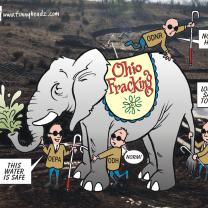
Ohioans were horrified to hear news stories about the spill of toxic material into the Ohio River from a West Virginia coal company. Some of our neighbors to the southeast still cannot drink their water.

What most Ohioans have not heard about is the intentional dumping of 20,000 gallons of radioactive and toxic fracking waste water into Ohio’s Mahoning River. Three tanker trucks full of so-called “brine” were deliberately pumped into a storm drain leading into the Mahoning on Thursday, January 31, 2013. More than a year later, it is still not clear exactly what chemicals the illegally disposed of waste contained.

The presence of radioactivity in the fracking waste could potentially keep Ohioans from drinking water in areas near the Mahoning River for thousands of years.

BANGKOK, Thailand -- The U.S. military begins its biggest training exercise in the Asia-Pacific region next week in Thailand where Washington does "not want to see a coup" by Bangkok's armed forces amid post-election protests attempting to overthrow a crippled democracy.

U.S. forces team up with two of their closest former Vietnam War allies, Thailand and South Korea, in a three-team "field training exercise...designed to enhance interoperability and strengthen regional relationships," the American Embassy said, announcing Exercise Cobra Gold 2014 which runs from Feb. 11-21.

Military services from Singapore, Japan, Indonesia and Malaysia join them for training "in a multinational force team that responds to a simulated scenario, executing a pre-developed operations plan."

Away from the heaviest training, military personnel from China "will participate in humanitarian and civic assistance projects designed to improve the quality of life and local infrastructure for the Thai people," alongside forces from the other countries.

Cobra Gold's annual multinational military exercise uses locations

Pages

Subscribe to ColumbusFreePress.com  RSS