Advertisement

CORNUCOPIA, WI – An industrial-scale organic dairy, located south of Phoenix in the desert Southwest, is poised to lose its USDA organic certification. The enforcement action at Shamrock Farms is the result of a USDA investigation into organic livestock management practices that was triggered by a formal complaint from The Cornucopia Institute.

Shamrock operates a massive dairy that was milking approximately 16,000 cows at the time of an inspection by Cornucopia staff in 2008. Between 700 and 1,100 of the cows at the split operation were in the organic milk herd; the remainder were part of a conventional dairy that is part of the same sprawling complex. Shamrock is Arizona's first-ever certified organic dairy.

"We found inadequate, overgrazed pasture adjacent to their milking facility, and we were told by Shamrock employees that the confined cows had not been out in weeks," said Mark A. Kastel, Senior Farm Policy Analyst for Wisconsin-based Cornucopia Institute, an organic industry watchdog.

Photo from rabbitsetc.us(photo by rabbitsetc.us) Sarah Von Alt, an animal rights activist working with Mercy For Animals supports the Occupy Movement. "MFA stands in solidarity with anyone who works to help animals, and I appreciate that the Occupy movement has included animals in its Official Declaration of the Occupation of New York City – specifically that corporate interests have 'profited off of the torture, confinement, and cruel treatment of countless nonhuman animals, and actively hide these practices.'"

Von Alt said as the Occupy movement continues to gain momentum, it is becoming more obvious that Americans have grown weary of corporate power in politics and the resulting abuses of humans and nonhuman animals.

Never doubt that simple acts of generosity and solidarity can change lives---and the world.

George Whitman and his Shakespeare & Company bookstore have been uniquely powerful living proof of that. And his daughter has guaranteed it will continue.

Nestled into the Left Bank of the Seine, a stoned throw from the magnificent Notre Dame Cathedral, George's bookstore has been a beacon of Bohemian/hippie/humanist/leftist writing and romance for decades.

Its roots stretch back to the great literary lights of the ex-pat 1920s and Beat 1950s. Hemingway and Fitzgerald, Joyce and Stein, Kerouac, Ginsberg, Corso....so much genius passed through the place its walls seemed to glow.

George Whitman, its owner since the 1940s, was known for letting budding young writers crash for weeks at a time. In the summer of 1967, I was one of them. Based on hippie urban legend, I sought the place out and asked if I could sleep on a couch upstairs.

Eyeing me suspiciously, George asked if I was a writer. I said I'd been a college editor, and had aspirations.

He said OK....I could have a week on the mattress.
Essam Al-Batsh and his nephew, Sobhi Al-Batsh, are the latest in a long line of reported Palestinian 'militants' killed by Israel. They were both targeted while driving in a car in downtown Gaza on December 8. According to an Israeli army statement, "(They) were affiliated with a terrorist squad that intended to attack Israeli civilians and soldiers via the western border" (Reuters, December 8).

Another 'militant' had been killed two days earlier. Israeli military aircraft "had targeted two militant squads that were preparing to fire rockets into southern Israel," according to the Associated Press. AP quoted Israeli official saying the army would "continue to take action against those (who) use terror against the state of Israel."

It really doesn't take much to kill a 'militant' in Gaza. Israeli military intelligence officers simply select a weapon and zoom in on their chosen person on any given day. This is not a difficult task really since the entire population of the Strip are besieged in Gaza's open air prison. The same statement issued regarding the assassinated 'militant' can then be easily rewritten, using the same predictable justifications.
Ambiguous but alarming new wording, which is tucked into the National Defense Authorization Act (NDAA) and was just passed by the Senate, is reminiscent of the “extraordinary measures” introduced by the Nazis after they took power in 1933.

And the relative lack of reaction so far calls to mind the oddly calm indifference with which most Germans watched the erosion of the rights that had been guaranteed by their own Constitution. As one German writer observed, “With sheepish submissiveness we watched it unfold, as if from a box at the theater.”

The writer was Sebastian Haffner (real name Raimond Pretzel), a young German lawyer worried at what he saw in 1933 in Berlin, but helpless to stop it since, as he put it, the German people “collectively and limply collapsed, yielded and capitulated.”

“The result of this millionfold nervous breakdown,” wrote Haffner at the time, “is the unified nation, ready for anything, that is today the nightmare of the rest of the world.” Not a happy analogy.

British Prime Minister Winston Churchill's fervent hope for years was that Japan would attack the United States. This would permit the United States (not legally, but politically) to fully enter World War II in Europe, as its president wanted to do, as opposed to merely providing weaponry and assisting in targeting of submarines as it had been doing. Of course, Germany's declaration of war, which followed Pearl Harbor and the immediate U.S. declaration of war on Japan, helped as well, but it was Pearl Harbor that radically converted the American people from opposition to support for war.

Ambiguous but alarming new wording, which is tucked into the National Defense Authorization Act (NDAA) and was just passed by the Senate, is reminiscent of the “extraordinary measures” introduced by the Nazis after they took power in 1933.

And the relative lack of reaction so far calls to mind the oddly calm indifference with which most Germans watched the erosion of the rights that had been guaranteed by their own Constitution. As one German writer observed, “With sheepish submissiveness we watched it unfold, as if from a box at the theater.”

The writer was Sebastian Haffner (real name Raimond Pretzel), a young German lawyer worried at what he saw in 1933 in Berlin, but helpless to stop it since, as he put it, the German people “collectively and limply collapsed, yielded and capitulated.”

“The result of this millionfold nervous breakdown,” wrote Haffner at the time, “is the unified nation, ready for anything, that is today the nightmare of the rest of the world.” Not a happy analogy.
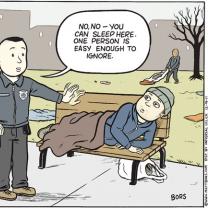
“The Lakotah had no language for insulting other orders of existence: pest, waste, weed . . .”

But what about “bugsplat”?

That’s the word for the cop at UC Davis, walking up and down the line of students sitting with their arms locked, zapping them in the eyes with pepper spray. It’s the word for the Tunisian police and bureaucrats who humiliated Mohamed Bouazizi and destroyed his livelihood as a street vendor. It’s the word for anyone whose power exceeds his humanity.

And, according to a 2003 Washington Post story, it’s the name of a Defense Department computer program for calculating collateral damage; it’s also, apparently, casual terminology among Pentagon operation planners and the like to refer to the collateral damage itself . . . you know, the dead civilians. CIA drone operators talk about bugsplat. The British organization Reprieve calls its effort to track the number of people killed by U.S. drone strikes — in Pakistan, Somalia, Yemen — Project Bugsplat.

Pages

Subscribe to ColumbusFreePress.com  RSS