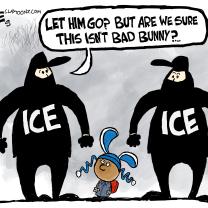
DHS Secretary Noem announced that federal agents in Minnesota will begin wearing body cameras. This comes after the world has been outraged about their behavior in U.S. communities — behavior that resulted in death and serious bodily injury.
In recent weeks, the United Arab Emirates has begun to put forward an initiative concerning the management of civilian affairs in the Gaza Strip after the war through organizing economic and service sectors, managing markets and commercial activities, and establishing logistical centers for distributing goods within the Strip.
What is striking about this initiative is that it was not presented within a comprehensive Palestinian or Arab framework but rather through direct talks with the United States and Israel, in a clear attempt to obtain their political and security approval. This suggests that the administration of Gaza is a matter to be decided in consultation with the occupying power and its main ally, not with the people of the land themselves.
On Tuesday, Feb. 3. at 11:59 pm, 15,000 Haitian immigrants are set to lose their "Temporary Protected Status" in Springfield, Ohio (population 60,000). Local residents are preparing for a 30-day ICE surge - even though conditions in Haiti are more dangerous than ever, thousands of children could be separated from their parents, and the Haitian community has helped fuel the small town's economic comeback. We stood up for Springfield, Ohio, when JD Vance and Donald Trump lied about Haitians who live and work there during the 2024 campaign, and we're doing it again now. Join us to hear from local residents and legal experts, help raise funds for local groups providing direct support to Haitian families in Springfield, and take action, no matter where you live.
Amid widespread revulsion at the behavior of the second Trump administration and its Republican loyalists, there is a curious tendency to blame Democrats for the slide of the United States toward fascism. As one enraged commentator put it recently, “the Democrats” have “let us down day by day by day.”
But, in fact, “the Democrats”―at the grassroots and at the federal government level―have repeatedly displayed overwhelming opposition to the rightwing Republican onslaught. By contrast, Republicans have almost uniformly backed Trump’s priorities. Indeed, the gap between the two parties on most key issues has been enormous.
After sold-out screenings across the country and multiple festival awards, the documentary Ain’t No Back to a Merry-Go-Round will screen at Columbus’ Gateway Film Center on Sunday, February 15. The latest film by Emmy-award winning filmmaker Ilana Trachtman (Praying with Lior, Mariachi High, Black in Latin America, etc.) recounts a watershed moment in American history: the first time Black student activists were joined by an organized white community to protest segregation. Together, they demonstrated against Washington, D.C.’s whites-only Glen Echo Amusement Park in 1960, provoking the first counter protests by the American Nazi Party, luring civil rights giants A. Phillip Randolph, Roy Wilkins, and Adam Clayton Powell to the picket line, and addressing the U.S. Supreme Court.
I am a member of the Association of American Editorial Cartoonists, and I also sit on its board of directors. Our president, Marc Murphy, wrote a statement for the organization in defense of journalist Don Lemon, who was arrested by the Trump regime for doing his job.
Don Lemon followed a protest into a church in Minneapolis, where the minister is an officer in ICE. Lemon had received a tip about the protest beforehand, so he went to the location to cover it. Donald Trump's Department of Justice figures that since Lemon knew beforehand of the protest, he must be a part of it. This displays either a total lack of understanding of how journalists often work or that the Trump administration is just out to get Don Lemon.