Columbus did not simply “have a year” in 2025. It ran an experiment.
The experiment was straightforward: Can a region stack national-scale industrial development on top of local-scale fragility and call it progress? It can — if the definition of progress is press conferences, ribbon cuttings and renderings that stop before the line item titled “who pays.”
A year-end recap that reads like a scrapbook misses the point. Columbus is a paperwork town pretending to be a destiny town. The only way to understand 2025 is as a ledger — what happened, what changed, and who absorbed the cost.
What follows is not a countdown. It is a map of the stories that defined Columbus in 2025.
Defense manufacturing: Anduril’s Arsenal-1 and the region’s identity shiftAnduril Industries announced “Arsenal-1,” a massive advanced manufacturing facility in Pickaway County near Rickenbacker International Airport, pitched at five million square feet on 500 acres, with production targeted for July 2026. Later in the year, JobsOhio approved a $310 million grant agreement tied to 4,008 jobs, more than $530 million in new payroll and more than $910.5 million in capital investment over 10 years.
This was not just a jobs announcement. It was an identity announcement: Central Ohio as national security manufacturing infrastructure. “Arsenal” was not subtle branding. It was the thesis.
Who won: Anduril, with subsidized speed; state development leaders who secured a trophy project; and the logistics-industrial corridor that keeps collecting wins.
Who paid: Taxpayers underwriting incentives; local governments asked to accommodate infrastructure demands that rarely make it into headline totals.
Who was ignored: Residents who were never asked whether “reindustrialization” should include autonomous weapons production — and workers who will carry the risk if timelines or demand shift.
Intel pushed the timeline for its Ohio semiconductor fabs further out, with completion and operations now targeted around 2030-31 for the first facility, with the second later.
That delay matters because it lengthens the gap between “future economy” promises and real, local outcomes. When a mega-project slips, the region does not only wait. It absorbs delayed supplier ecosystems, delayed workforce alignment, delayed tax-base expectations, and a long period of “always in progress,” when scrutiny becomes harder because the finish line keeps moving.
Who won: Intel, which buys time; officials who keep the headline even when the calendar slips.
Who paid: Communities and workers planning around a promised cadence; taxpayers underwriting the ecosystem narrative while timelines drift.
Who was ignored: The public’s right to clear answers about public costs, infrastructure externalities, and what happens if a once-in-a-generation bet becomes a decade-long holding pattern.
One of the most consequential stories of 2025 was also one of the least visible: data centers and utility cost allocation.
State regulators pushed AEP Ohio toward a data-center-specific tariff to prevent grid expansion costs from being shifted onto ordinary customers. AEP’s data center tariff became effective in late July. Separately, reporting described estimates that average customers could see significant bill increases over time, with data center demand described as a major driver.
This is what the region’s growth model looks like when it stops being abstract and starts showing up on monthly statements. Data centers do not announce themselves like factories with thousands of jobs. They arrive as grid upgrades, land-use conflicts, water questions, and policy fights over whether “economic development” includes the right to socialize costs.
Who won: Early entrants who benefited before rules tightened; regulators and utilities forced to treat cost-shifting as a structural issue.
Who paid: Residents who absorb incremental increases; communities living with land-use and water impacts; small businesses without leverage in the process.
Who was ignored: The public demand for a straight answer: what is the real per-household cost of becoming a national data-center hub?
Jerome Township trustees approved a nine-month moratorium on new data center development amid resident complaints and concerns about local impacts.
That move mattered because it signaled a local shift: “No” is a governing tool, not a failure of ambition. It also exposed a regional planning gap — a statewide demand curve is being fought township by township.
Who won: Residents who forced deliberation; local officials who acknowledged limits.
Who paid: Townships now spending time and money designing guardrails — planning, legal review, and enforcement.
Who was ignored: The absence of regional governance strong enough to manage regional-scale infrastructure demand.
LinkUS and the West Broad bus rapid transit corridor remained a long-term infrastructure story, with project materials pointing to preconstruction work and a groundbreaking in 2026, and service targeted for 2028.
This is the “eat your vegetables” story — the one that will not trend but will determine whether Columbus becomes more livable as growth continues. The region can recruit megaprojects, but without modern mobility, it becomes a traffic experiment with better branding.
Who won: If it delivers, riders and corridors historically treated as afterthoughts.
Who paid: Businesses and residents along the corridor during construction; taxpayers funding the long game.
Who was ignored: People who need transit now, not in 2028 — and neighborhoods that keep getting promised mobility “later.”
Columbus voters approved a $1.9 billion bond package to fund affordable housing and a wide range of city improvements. The city’s package included $500 million for neighborhood development and affordable housing.
Bond passage is not the victory. It is permission. The real story begins after the ballot: where the money lands, who gets contracts, what counts as “affordable,” and which neighborhoods see results first.
Who won: City leaders who secured borrowing authority; contractors and developers positioned for capital spending.
Who paid: Residents over time through debt service; communities that may be told “we spent billions,” even if their block does not change.
Who was ignored: The accountability phase — implementation is quieter than campaigning.
A former Columbus police officer was sentenced to life in prison with parole eligibility after 15 years for the killing of Andre Hill, an unarmed Black man.
The case was a major accountability outcome for a city that has spent years debating reform in the abstract. But legal closure is not civic repair. Trust is not a court outcome. It is a pattern outcome.
Who won: The Hill family saw a rare form of accountability; the public saw the system impose a severe penalty.
Who paid: The city and the public carry the long-term cost of distrust and reform failure; communities carry the weight of repeated trauma.
Who was ignored: The broader reform machinery that cannot run on one conviction — training, discipline, enforcement, and policy compliance.
Columbus City Schools approved more than $50 million in cuts and voted to close four schools as it confronted a major financial shortfall.
This was not only a school district's story. It was a regional contradiction. Columbus cannot market “jobs of the future” while treating the public institution that prepares children for that future as a budget problem to be minimized.
Who won: No community truly wins school closures — except the ideology that public systems should shrink until they stop demanding resources.
Who paid: Families, staff, and neighborhoods losing anchors; students absorbing disruption as “efficiency.”
Who was ignored: Structural funding realities, transportation and stability costs for children, and equity impacts.
Nationwide Children’s Hospital announced it would end gender-affirming prescriptions, citing a rapidly changing regulatory environment, while continuing other services.
This was a local healthcare institution making a preemptive move within a political and legal climate that now reaches into clinical decisions in real time. Regardless of ideology, the practical impact was immediate for patients and families.
Who won: Political forces pushing ideology into medicine; institutions reducing legal exposure by shrinking services.
Who paid: Patients and families navigating disrupted care and uncertainty.
Who was ignored: The practical questions — capacity, continuity, cost and outcomes — that determine whether “we’ll work with patients” is meaningful.
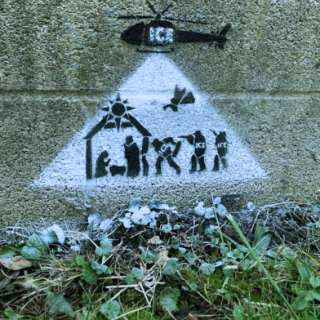
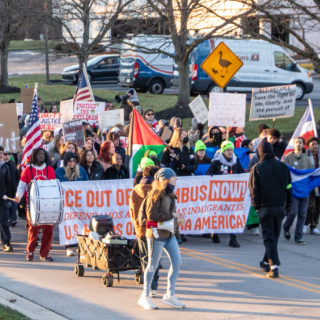
Federal immigration officials announced “Operation Buckeye” in December, describing it as a major enforcement effort. Local reporting and community responses questioned transparency, documentation, and the broader impact on families and neighborhoods.
The story was not only arrests. It was the sudden shift in civic temperature — fear, uncertainty, and a narrative battle about who is labeled “dangerous” and what accountability looks like.
Who won: Federal agencies that benefit from blunt messaging; politicians who convert fear into legitimacy.
Who paid: Families and communities absorbing stress, disruption, and a chilling effect on daily life.
Who was ignored: Documentation standards — names, charges, jurisdictions, and due process outcomes — because slogans are easier than records.
Library workers submitted union cards representing a supermajority to begin an election process, seeking representation.
In a year dominated by billion-dollar narratives, the library story offered a different kind of power shift: workplace leverage inside a public institution that functions as social infrastructure — internet access, job searches, youth programming, and community support.
Who won: Workers asserting leverage; potentially the public, if staffing and retention improve.
Who paid: The costs of bargaining and conflict if management chooses resistance over negotiation.
Who was ignored: The long-term question: why did it take a union drive for workplace concerns to be treated as urgent?
Columbus acted like a city that is already rich — while arguing over whether it can afford the basics.
The major question heading into 2026 is not complicated: Will Columbus become a city that works for the people who already live here, or a region that closes deals and sends residents the bill?